Last night I listened to Colin Blunstone's Journey and noticed a small thing about "Beginning." The choral background doubles the "surrounds you in the night" in the line "Oh, self-doubt surrounds you in the night." The choral background surrounds Blunstone's lead vocal just like the self-doubt in the lyric.
I noticed a small thing about "Beginning" for my Collection Audit project.
"Beginning" is one of the songs that Blunstone re-recorded for The Ghost of You and Me, but instead of a choral backing, that version has a string section. So - as far as this feature is concerned - the original is actually better because the string version doesn't have that vocal surrounding to mirror that lyric.
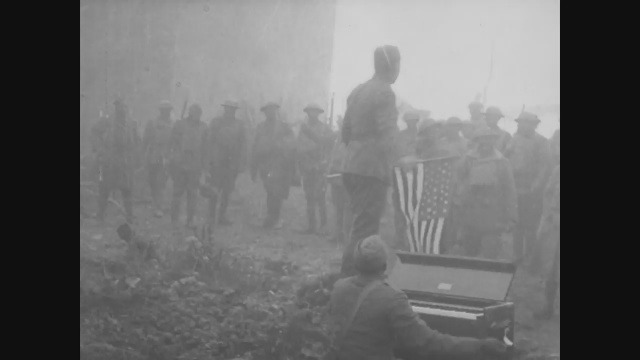
Because I'm a nerd, I'm subscribed to the U.S. National Archives YouTube channel. About two weeks ago, they uploaded a bunch of old footage from World War I, and I'm just now getting around to watching it.
From about 2:05 to 2:10 in this video, there are some shots of a man playing a harmonium:
I don't know the complete history, but apparently harmoniums were used in the army even until the Korean War. I'd always assumed that the Zombies used one on "Butcher's Tale" because of its sort of eerie sound, but seeing one in this old footage made me realize that it's actually a historically accurate choice of instrumentation.
Yester-day I listened to the Into the Afterlife album. I found a couple parts that sounded easy, and I'm going to try to figure them out, but no promises on those. What I really want to write about is "Ma non è giusto," the Italian version of "She's Not There."
I've been learning Italian for two years, and I've practiced it everyday since March. While I'm far from fluent, I'm getting pretty good, so I could pick out some more words in the lyrics. The first line starts with "È così triste" ("It's so sad"), which certainly sounds like a Zombies song. I also heard "Tu sei che" ("You know that"), "ma più di te" ("but more than you"), and - I think - "ci incontriamo" ("we meet"). It's an excruciatingly slow process, but I am transcribing and (sort of) translating it. Like I mentioned one other time, the Italian lyrics seem to depart from Argent's original lyrics.
After I listened to the album and was thinking about these Italian lyrics, I realized that the Zombies are half of the reason I started learning Italian in the first place. Chris White wrote "Brief Candles" loosely based on Aldous Huxley's book of short stories of the same title. About five years ago, I got a copy of Brief Candles, and when I was re-reading it two years ago, I felt kind of stupid because I couldn't understand the Italian phrases in "The Rest Cure," one of the stories. (At the same time, I was also reading Dante's Divine Comedy, and - even though this was an English translation - there were still some Italian phrases, with which I had the same problem.) So I started learning Italian on Duolingo. It seems to be going pretty well.
I don't think my recording really does this justice.
I can't change the tone of the organ presets on my keyboard (an-other reason why getting a Nord - with physical drawbars! - would be such an advantage), so the organ tone doesn't match that well.
The bass during the repeated part at the end (which I played only part of because I don't know the whole mellotron part) is more complex than what I played, but I haven't figured out that part perfectly yet. This is actually a lot more than I thought I was going to do when I said I figured out some of the bass part. Mostly I was talking about the staccato notes and the long phrases that replace them later (one of them extends two whole octaves, up to the twelfth fret G), but then I kept learning more of it. In Deep is the only Argent album I have as a record, so I can refer to the record sleeve for publication data (I'm not always too confident that what I find on the internet is right). The record credits "Losing Hold" to Argent and White:
According to the Zombie Heaven liner notes, Argent and White wrote separately but starting with "Imagine the Swan" they shared the writing credit. Because of this ambiguity, I sometimes wonder if a song is an Argent or White song. Obviously, I'm not sure of this, but I would guess that "Losing Hold" is a Rod Argent song because it has some of his characteristic three-note chromatic phrases in the bass part. The staccato notes at the beginning are A G# G, over which are played A major, C# minor, and G major; the chromatic phrase starting from the root note of the first chord in the sequence is a very Argentian progression. Later, during the repeated section at the end, there's a three-note chromatic phrase of C B Bb.
The chord progression has some resemblance to that of "Hung up on a Dream" too. They both have a section where each chord is only one note different from the previous. In "Hung up on a Dream" it's G major (G, B, D) to E minor (E, G, B) to C major (C, E, G). Here, there's a section of F major (F, A, C) to A minor (A, C, E) to C major (C, E, G) to E minor (E, G, B) to G major (G, B, D). This sort of incremental progression is more visually obvious on a keyboard instrument, which makes me think it's Argent's song.
When I listened to In Deep a couple days ago, I thought this part (doubled on piano and tubular bells) from "Be Glad" would be easy to figure out. It's only a couple bars from around the six minute mark, but because I figured this out, I'm pretty sure the song is in G major.
Last night I listened to Argent's In Deep, and I noticed two small things about two songs.
"God Gave Rock and Roll to You"
The first line of the first verse is "Love your friend and love your neighbor," and the "Love your neighbor" part is a quote from the Bible. I think it's actually in a couple places, but this is the first one I thought of:
But when the Pharisees heard that he [Jesus] had silenced the Sadducees, they gathered together. And one of them, a lawyer, asked him a question to test him. "Teacher, which is the great commandment in the Law?" And he said to him, "You shall love the Lord your God with all your heart and with all your soul and with all your mind. This is the great and first commandment. And a second is like it: You shall love your neighbor as yourself. On these two commandments depend all the Law and the Prophets." (Matthew 22:34-40)
For what it's worth, last year, I wrote about what I think are some more Biblical references (to the Sermon on the Mount) in "It's Only Money, Pt. 1" and "It's Only Money, Pt. 2" (a lot of the lyrics are the same in both songs).
"Losing Hold"
I'm surprised I hadn't noticed this before, but "slide" in the line "Let my fingers slide" has a melisma. Instead of being sung as just one syllable, it's sung as two, and the note changes from an A to a B, so the word "slide" is itself sliding between those two pitches.
I found some more things about some songs from In Deep. I also (finally!) sussed out a couple lines for my transcriptions: "Gathering together a chandelier of time" in "Candles on the River" and "The thoughts in such a mind don't belong" in "Rosie."
I also figured out the part in "Be Glad" that's doubled on piano and tubular bells and - while I was figuring out the notes for that "slide" - the bass part at the very beginning of "Losing Hold." I'll get around to recording and posting those in the next few days.
I'm getting to this late, but here are the chords for "I Want Her She Wants Me."
Introduction
|: G major / D major / C major / G major :|
Verses:
G major / F# minor / B major / E minor
Note: This E minor has some extra notes played on top of it. First, it's just a regular E minor, with the top string open (an E note). Then, the top string plays an F#, a G, back to F#, and then back to a regular E minor.
I was too busy to make a note of this at the time, but yester-day was the 51st anniversary of an-other Zombies recording session. On 24 June 1965 (incidentally, Colin Blunstone's 20th birthday), they recorded, "Don't Go Away," "I'll Keep Trying," and "Whenever You're Ready."
Like most of the songs from the 12 June session, I haven't learned any more parts to these since I last recorded them, so I won't be posting new versions.
Yester-day I listened to the I Love You album, and I noticed a couple things. One of them is about "I Love You," and since it's a musical thing and the anniversary of the recording is in about two weeks (8 July), I'll wait until then for that.
Here's the second thing then; it's about the bass part in "She's Not There." I still don't know the whole thing, but I know the part during the verses, which is the significant one here. It's the part during the "Well, let me tell you 'bout the way she looked" sections that I don't know yet.
I'd always thought that the bass part during the electric piano solo was just the same as it is during the verses, but there's a small change in rhythm. At the beginning of the song, the bass part goes like this:
For the first bar of the electric piano solo, the bass part is the same, but then the first quarter note in each bar (an A note) changes to two eighth notes:
I really need to make a list of the songs that do this, but "She's Not There" is one of the earliest Zombies songs that has this feature: the bass part under the solo could be exactly the same as it is during the verses (the solo is based on the same chords as the verses are), but there's a change that makes it a little more complex.
Originally, I'd intended to post the guitar chords for "Care of Cell 44" with the mellotron part written out in notation. In notating it though, I found some parts that I'm not sure I have right. I'm pretty sure of the chords though, so I'm posting only those.
Verses:
|: G major / D major / E minor / D major / C major / B minor / A minor / D major
G major / D major / Bb major / Dsus4 / D major :|
For the "Feels so good" section:
G major / D major / E minor / D major / C major / B minor / A minor
There is no guitar part during the bridge. You could play the piano chords for that part on guitar, but I'm a purist and wouldn't advocate it, so I'm not listing those chords here (if you're that determined though, you could find them elsewhere on this blog).
Near the end, after the "Feels so good" section there's a G major to G major dominant 7th (G7) modulation, and then the progression from the "Feels so good" section is repeated, resolving to a G major at the end.
According to both the Zombie Heaven liner notes and Russo's Collector's Guide, the Zombies' "Indication" b/w "How We Were Before" (Decca F.12426) was released in the U.K. fifty years ago to-day (17 June 1966).
I ran across the initial notes I made a year ago that ended up in this post about "Butcher's Tale," and I discovered that I forgot to mention something.
I didn't (and still don't) understand what the line "But the king's shilling is now my fee" really means, but a year ago, I realized that "shilling" sounds a bit like "shelling," so the accoutrements of war are sort of present even in the first verse.