Showing posts with label Butcher's Tale. Show all posts

Sunday, March 9, 2025

Odessey and Oracle

Yester-day was the anniversary of the concert that was recorded for the Odessey & Oracle {Revisited} CD and DVD (on 8 March 2008), so I watched it again.  In the original album liner notes, there's a quote from Shakespeare's The Tempest:
Be not afraid;
The Isle is full of noises
Sound, and sweet airs that give delight and hurt not.
Sometimes a thousand twangling instruments
Will hum about mine ears; and sometimes voices
Caliban says this to Stephano and Trinculo in Act 3, Scene 2 (roughly lines 131-134), although in the two editions of the play that I have, it's formatted a bit differently:
Be not afeard.  The isle is full of noises,
Sounds and sweet airs that give delight and hurt not.
Sometimes a thousand twangling instruments
Will hum about mine ears, and sometime voices
That, if I then had waked after long sleep,
Will make me sleep again
I recently re-read The Tempest and noticed a detail that, purely coincidentally, is related to this 40th anniversary concert version of "Butcher's Tale."  During the concert, Rod comments on the "1896 Victorian pedal organ similar to the one [used on the original recording] that Chris gave away many years ago and I had to go searching for for these concerts."  In a few shots, it can be seen that the organ was made by the Clarabella Organ Co.:


In The Tempest, Alonso's daughter (who's merely mentioned in the play, at II.i.68, 240, 253, and V.i.209) is named Claribel, which is just a slightly different form of Clarabella.

In re-reading The Tempest, I also noticed that the word oracle appears a couple times.  At the beginning of Act 4, Scene 1, after Prospero tells Ferdinand that Miranda "will outstrip all praise," Ferdinand replies, "I do believe it / Against an oracle" (lines 11-12), and in Act 5, Scene 1, Alonso, reflecting on his experience on the island, says,
This is as strange a maze as e'er men trod,
And there is in this business more than nature
Was ever conduct of.  Some oracle
Must rectify our knowledge.  (lines 242-245)
Caliban's lines are quoted in the liner notes, so maybe one of these instances of oracle had something to do with the album's title.

The title also seems to reference the Greek epic poem The Odyssey, and it occurred to me that The Odyssey and The Tempest both deal with maritime voyages (although most of The Tempest occurs after a shipwreck).

---&---

For what it's worth:  on Rod's birthday a couple years ago, the Zombies' social media accounts (Facebook, Instagram) posted an old picture of him at an organ, and this seems to be the original "Butcher's Tale" organ.

Monday, September 18, 2023

"Butcher's Tale"

Last month, I was thinking about one of the sound effects in "Butcher's Tale."  In the liner notes to the fiftieth anniversary edition of Odessey and Oracle, Andrew Sandoval describes it as "added intrigue from Rod on electronic oscillator."  Chris White confirms this in Claes Johansen's book The Zombies: Hung up on a Dream:  "There were no synthesizers in those days... the thing at the end is just an oscillator which Rod played on another track" (p. 171).  I think it's basically a glissando from A to D an octave higher.

Last night, I made a recording of the harmonium and oscillator parts.  I used my Hammond SKX for the harmonium (specifically Reed Organ 2 with Hall 2 reverb set at 26) and my Moog Subsequent 37 for the oscillator.  I'm still way out of my depth with the Moog, but I tried to use a simple setting.

I played the harmonium part from memory, and I didn't use a click track, so it may vary in accuracy and tempo.


Saturday, April 16, 2022

"Butcher's Tale"

I was thinking about "Butcher's Tale" last night, specifically:
And I can't stop shaking
My hands won't stop shaking
My arms won't stop shaking
My mind won't stop shaking
I realized that there are a couple features here that illustrate the incessant nature of this shaking.

Of course, there's the repetition of the word itself and even of the structure of the lines.  Different body parts are substituted, but each line ends with the phrase "won't stop shaking" (the rhetorical term for this structure is epistrophe).

The first line is a bit different, but the other three lines are all sung to the same melody, something like:


The repetition of this melody not only contributes to the incessant feeling, but it also emphasizes the lines' similarity.

Wednesday, December 18, 2019

"Butcher's Tale"

I'm nearly finished with reading Martin Gilbert's The Somme; lately, I've just been studying the maps in the back of the book.  Yester-day, I realized something about the places mentioned in "Butcher's Tale" - "And the flies came down in Gommecourt, Thiepval, / Mametz Wood, and French Verdun."

Coincidentally mirroring that "came down," the places are listed from north to south.  Here's a screen clipping I took of Google Maps:


I also started wondering why Verdun is specified as French when in fact all of these places are located in France.  As I understand it, both French and British Commonwealth troops were involved in the fighting around the Somme, but only French troops were involved in the fighting in Verdun.  The song seems to be from the perspective of a British soldier (in interviews, Chris White has mentioned his uncle who fought and died on the Somme), which somewhat explains this distinction.

Wednesday, September 12, 2018

"Butcher's Tale"

Although my flute skills aren't advanced enough for me to play hardly any of them, I follow the daily music pieces posted on flutetunes.com.  A couple days ago, they posted a piece titled "The Queen's Shilling."  Accompanying the piece, there's a short paragraph that explains that "the queen's shilling" or "the king's shilling" is "a historical slang term referring to the earnest payment of one shilling given to recruits to the Armed forces of the United Kingdom."  Here's Collins' dictionary entry for "king's shilling."

Now that I've learned this term, I finally understand one of the lines in "Butcher's Tale" a bit better: "But the king's shilling is now my fee."

Sunday, June 10, 2018

"Butcher's Tale" b/w "This Will Be Our Year"

According to Russo's Collector's Guide, fifty years ago to-day (10 June 1968), the Zombies' "Butcher's Tale" b/w "This Will Be Our Year" (Date 2-1612) was released in the U.S. and Canada.

Wednesday, May 23, 2018

"Butcher's Tale"

I've been reading a book about World War I (The Somme by Martin Gilbert), and this morning I read about some German ammunition dumps that were destroyed in a British shell barrage on 25 June 1916.  One of the places listed was Mametz Wood, which - of course - got me thinking about "Butcher's Tale" and the lines "And the flies come down in Gommecourt, Thiepval / Mametz Wood, and French Verdun."  I realized a couple things about these lines.

Listing places (or people) like this is a rhetorical technique called cataloguing.  Here, because of the number of places listed, there's a sense of the multitude of flies that are "com[ing] down."

The other thing I realized is that this cataloguing connects (albeit loosely) to the title Odessey and Oracle.  Cataloguing is a convention of epic poetry, and a prime example of epic poetry is The Odyssey, which is referenced in the album title.

Sunday, April 22, 2018

"Butcher's Tale"

The last thing I noticed when I listened to Odessey and Oracle on the anniversary of its release date is that the phrase "the flies come down" in the line "Then in the heat the flies come down" in "Butcher's Tale" descends (E D A A), giving a musical impression of that "com[ing] down."

Wednesday, November 29, 2017

Odessey and Oracle

According to the Zombie Heaven liner notes, fifty years ago to-day (29 November 1967), the Zombies mixed the stereo versions of "Butcher's Tale" and "A Rose for Emily."

Thursday, July 20, 2017

"Butcher's Tale"

According to the liner notes of both Zombie Heaven and the 50th anniversary edition of Odessey and Oracle, fifty years ago to-day (20 July 1967), the Zombies recorded "Butcher's Tale."

The liner notes in Zombie Heaven provide additional information about some other Odessey and Oracle songs.  In full, the 20 July entry reads: "EMI Abbey Road No 3 recording: 'Butcher's Tale' (master), 'A Rose for Emily', 'Hung up on a Dream', 'Butcher's Tale' (mono mixing)."  If I understand this correctly, along with recording "Butcher's Tale" on 20 July, the Zombies also completed mono mixes of "A Rose for Emily," "Hung up on a Dream," and "Butcher's Tale."

Thursday, June 30, 2016

"Butcher's Tale"

Backdated, archival post

[link to original on tumblr]

---&---

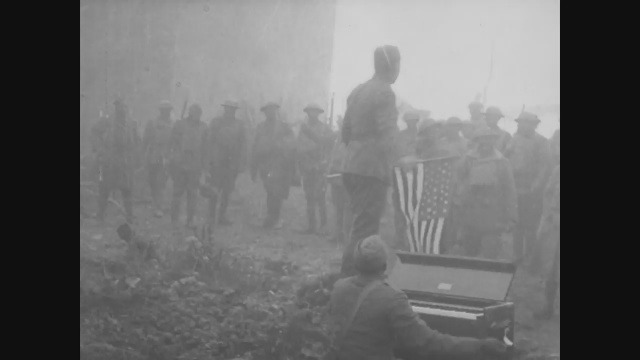
Because I'm a nerd, I'm subscribed to the U.S. National Archives YouTube channel.  About two weeks ago, they uploaded a bunch of old footage from World War I, and I'm just now getting around to watching it.

From about 2:05 to 2:10 in this video, there are some shots of a man playing a harmonium:


I don't know the complete history, but apparently harmoniums were used in the army even until the Korean War.  I'd always assumed that the Zombies used one on "Butcher's Tale" because of its sort of eerie sound, but seeing one in this old footage made me realize that it's actually a historically accurate choice of instrumentation.

Thursday, June 16, 2016

"Butcher's Tale"

Backdated, archival post

[link to original on tumblr]

---&---

I ran across the initial notes I made a year ago that ended up in this post about "Butcher's Tale," and I discovered that I forgot to mention something.

I didn't (and still don't) understand what the line "But the king's shilling is now my fee" really means, but a year ago, I realized that "shilling" sounds a bit like "shelling," so the accoutrements of war are sort of present even in the first verse.

Wednesday, April 13, 2016

"Butcher's Tale" and "Friends of Mine"

Backdated, archival post

[link to original on tumblr]

---&---

I was thinking about this a few days ago, but I forgot until earlier to-day.

Part of the chord progressions for "Butcher's Tale" and "Friends of Mine" are sort of the same, which makes some sense since they're both Chris White songs.

There's a progression in "Butcher’s Tale" that's F major, Bb major, F major, A major, and there's a progression in "Friends of Mine" that's C major, F major, C major, E major.  There's a significant difference though in that "Butcher's Tale" is in D minor and "Friends of Mine" is in C major, so if you write those sections of the chord progressions in Roman numerals, it's III VI III V for "Butcher's Tale" and I IV I III for "Friends of Mine."  The relationship between each group of four chords is the same even though they start on different scale degrees and are in different keys.

I should add a disclaimer to this that while I think I'm right, I don't have any training in music theory so I could have gotten this wrong.

Sunday, October 11, 2015

Odessey and Oracle

Backdated, archival post

[link to original on tumblr]

---&---

When I wrote this post about the Picardy third in "Time of the Season," I was dimly conscious of the Picardy third in "Butcher's Tale," but then I got thinking about them some more and I realized that they're pretty similar in that the Picardy third comes at the end of a section, and that section is just repeated to make up the song.  (This might not be strictly true of "Time of the Season" because that section changes a bit for the organ solos.  The basis is fairly similar, but I don't think that Picardy third is there because there aren't any vocals.)  In any case, those similar structures are an-other feature that gives the album a coherence.

Also, because I'd been oblivious to that Picardy third for so long, I thought, "What other things am I missing!?"  So I was thinking about the album and looking at the lyrics, and I discovered something about "Brief Candles."

There's a great feature in the parallel phrase in the third line of the first verse: "To realize that she was strong and he too weak to stay."  There are two clauses (as objects of "realize") here: "she was strong" and "he too weak to stay."  That second clause doesn't have a verb of its own; it's only understood through that parallel structure and taking the verb from that first clause.  So: "she was strong and he [was] too weak to stay."  The he is sort of a parasitic pronoun in that it has to use the verb from the other clause; like the person it refers to, it's weak.

Wednesday, September 9, 2015

Odessey and Oracle

Backdated, archival post

[link to original on tumblr]

---&---

I listened to Odessey and Oracle to-day (with bonus tracks), and I discovered a lot of new things!

"Care of Cell 44"

The last three lines of the first verse all start with words that end in "-ing," but their meaning is sort of ambiguous.
Good morning to you I hope you're feeling better, baby
Thinking of me while you are far away
Counting the days until they set you free again
Writing this letter hoping you're OK
The "thinking" seems to go along with the "you're" from the previous line, so: "I hope you're feeling better [and] thinking of me...."  (Although the "thinking of me..." could also be a participial.)  The subject of "counting" could be either the "you" or the singer/speaker.  "I hope you're... counting the days..." or "[I am] counting the days."  (Again, "counting the days..." could be a participial too, modifying either the "you" or the speaker/singer.)  The subject of "writing" is clearly the speaker/singer.  Things could be divided a couple different ways there.

"A Rose for Emily"

There's an extra line in the second and third verses (which I knew), but this time I realized the significance of the music's repetition there.  The chords under the second half of "The roses in her garden fade away" (A and Bm) are also used for the next line: "Not one left for her grave."  Musically, there's a return to "the roses in her garden," as if to check if there's one for her grave.

"Maybe after He's Gone"

There's some parallelism in the lines "I feel I'll never breathe again / I feel life's gone from me."  Particularly because both start with "I feel," "I'll never breathe again" is equated to "life's gone from me."

"Brief Candles"

I got thinking about the "tight" in the first line: "There she sits her hands are held, tight around her glass."  In that rendering, it's an adjective, but it could also be parsed as a flat adverb:  "There she sits her hands are held tight[ly] around her glass."  There's no real difference in the meaning, but grammatically it's different.

I also discovered a consistency in the rhyme scheme.  Each verse has a rhyme scheme of AABB, but the B's carry over: the last two lines of the first verse end with "stay" and "way;" the those in both the second and third verses end with "say" and "way."

I think I noticed this before but forgot to write about it: the vocals are double-tracked during Blunstone's verse (as are the others'), except for the second "say" in "He does not say a single word, no word of love to say."  It draws attention to itself because that second voice is missing, and it musically portrays the lack of a "word of love."

"I Want Her She Wants Me"

The continual repetition of "I want her she wants me" at the end mirrors the cyclical nature of the statement itself.  It just keeps going around.


"Butcher's Tale"

I noticed this earlier, but I've neglected to write about it:  the repetition of the "can't/won't stop shaking" line reflects the inability to cease.

A new thing I noticed though is the rhyme scheme of the first verse, which is different from all the others.  The first verse has ABAB ("trade," "fee," "stayed," "see") where the others are ABCB.  So as the speaker/singer looks back on his past life ("A butcher, yes, that was my trade...") things have a stronger coherence than they do once he goes to war.


"Friends of Mine"

I'd previously noted the parallelism in "That's something to see; that's nothing to hide," but I noticed a new one in the chorus:  "And they've got something it's so hard to find" parallels with "And they've got something you don't often find."  It's not as strictly parallel as some other instances, but it's pretty close.

—Bonus Tracks—
"I'll Call You Mine"

I've been meaning to mention this since 19 April:  although "I'll Call You Mine" is a bonus track, it works really well sequenced after "Time of the Season" (as it is on one of the Odessey and Oracle CD re-issues I have) because they're in relative keys.  "Time of the Season" is in E minor, and "I'll Call You Mine" is (at least mostly) in G major.

I did notice a new thing too.  During this section:
I couldn't chance to break the spell we had
The happy times we had, and yet the times were sad
Just for me, baby, you understood then
I was afraid to try to call you mine
Blunstone is singing the lead vocal, and Argent is doing the harmony vocal.  But Argent's harmony vocal drops out for the third line.  So there's only one voice (Blunstone's) singing "Just for me...."  It emphasizes the exclusivity.

"Don't Cry for Me"

An-other thing I've neglected to write about:  the "down" in the lines "Don't break your heart / Thinking you have let me down" is broken into syllables (a melisma), and the later notes are lower in pitch, so the word itself is going down.

"Smokey Day"

Like the "tight" in "Brief Candles," there are words here that could be either adjectives or flat adverbs:  "Soft, serene, she dances" or "Soft[ly], serene[ly] she dances."


"She Loves the Way They Love Her"

Surely I must have noticed this before, but I don't think I've written about it:  in the first line of the third verse, there's a multitude of internally-rhyming words:  "Crying, dying, sighing, whining, shining in the microphone."

Thursday, June 18, 2015

"Butcher's Tale"

Backdated, archival post

[link to original on tumblr]

---&---

Yester-day I was playing "Butcher's Tale," and I realized that the shaking section ("And I can't stop shaking / My hands won't stop shaking / My arms won't stop shaking / My mind won't stop shaking")  is comprised of (mostly) the same notes that provide the bass part for the verses.  The "And" is on a C, but otherwise, those phrases cycle through D, E, F, F, E, D (ending on an E), and the bass part for the verses is a repeated D, F, E, D.

I'm not sure if there's anything extra-musical about this (as if it's meant to connect those shaking sections with the verses), but it at least provides a unifying musical element to the song.

Tuesday, June 16, 2015

"Butcher's Tale"

Backdated, archival post


---&---

I got thinking about "Butcher's Tale" this morning when I was trying to go to sleep, and I realized two things about it:

1.  The line "And the preacher in his pulpit" has alliteration, and - unlike most of the alliteration I mention - this instance is actually significant.  The alliterative sound is the P, which is a plosive.  So that recurring P sound mimics the sound of the bombs and shells and that singer/speaker would encounter on the battlefield.

2.  There's internal rhyme in the line "Sermon: go and fight, do what is right."  And - again - there's significance to this (it's also the only internal rhyme in the song).  It's suggestive of a larger pool of rhetorical devices that the preacher might use in his sermon.

I checked the recording, and that line ("Sermon: go and fight, do what is right") is the only line during the verses that has legato chord transitions.  During the rest of the lines, there's a staccato interchange between chords and the bass notes.  So, musically, there's something different about that line too.

When I looked at my transcription to confirm these lines, I noticed that the line following "Sermon: go and fight, do what is right" is "But he don't have to hear these guns."  The intentional mis-use of "don't" ("he don't" instead of "he doesn't") illustrates further distance between the singer/speaker and the preacher.  There's the ideological distance and resentment that the song specifically mentions ("But he don't have to hear these guns / And I bet he sleeps at night" and "If the preacher he could see those flies / Wouldn't preach for the sound of guns"), but there's also the distance illustrated by that rift of language - the preacher uses rhetorical devices where the soldier can't even make his subject and verb agree.  The pleonastic "he" in "If the preacher he could see those flies" also seems to underscore this distance.

Sunday, May 3, 2015

"Butcher's Tale"

Backdated, archival post

[link to original on tumblr]

---&---

A little over a week ago (23 April), I was playing "Butcher's Tale," and I realized (again) that there are Picardy thirds at the end of each section.  The song starts in D minor (with some accidentals), but half-way through, it moves to D major.  Then it restarts in D minor again before finally ending with D major.  The transition from D minor to D major (an F note to an F#) occurs during the last "home" in the "I want to go home / Please let me go home / Go home" part.  The vocals end on that F# note, emphasizing that F-to-F# change.

I got to thinking about this, especially because the lyric accompanying that Picardy third contains "home" and I've written about the lyrical/musical connections with "home" before (with "She's Coming Home" and "Care of Cell 44").

The Picardy third and "home" together are particularly significant here, considering the subject matter in the song.  The period following World War I (or even during it) was filled with disillusionment, and the ending of "Butcher's Tale" demonstrates that really well.  The vocals don't go to the root note (D) almost as if they can't go home again after having witnessed the horrors of war ("a friend of mine / Hang[ing] on the wire like some rag toy").  And they don't go to the minor third (F) almost as if they don't want to emphasize the sadness that minor chords seem to signify.  Instead, they go to the major third (F#).  They seem to yearn for something higher - both literally (F# is higher than D) and figuratively (as if the "home" mentioned in the lyrics is a spiritual home above the old Earthly home [id est: Heaven]).

Tuesday, March 3, 2015

Odessey and Oracle

Backdated, archival post

[link to original on tumblr]

---&---

I listened to Odessey and Oracle (with bonus tracks!) to work on transcribing the lyrics (which I think I'm almost finished with), and I noticed a lot of things.  I'm still slightly astounded that I'm only now discovering some things about this album, but at the same time, I hope I continue to do so because it just makes me love it so much more.

In the verses of "Beechwood Park," certain words are repeated within a line, ostensibly to further the images.  There's "Do you remember summer days just after summer rain" and "Do you remember golden days and golden summer sun."

Also in "Beechwood Park," there's assonance (and internal rhyme with "dark" and "park") in the line "And we would count the evening stars as the day grew dark in Beechwood Park."

If you isolate the backing vocals for the verses of "Hung up on a Dream," you can get some (perhaps relevant, perhaps irrelevant) statements:  "Gentle love / turned me on to sounds unheard" and "Sometimes I think I'll never find / Gentle love."

I'm still not sure about the lyrics in "Changes," but what I currently have is:
I knew her when summer was her crown
And autumn sighed how brown her eyes 
I knew her when winter was her cloak
In spring her voice she spoke to me
In checking my transcription, I noticed that the poetic device here isn't line-ending rhyme, but internal rhyme:  "crown" with "brown" and "cloak" with "spoke."  I also noticed that the summer/autumn couplet appears two more times than the winter/spring couplet, which - along with "Do you remember summer days just after summer rain" from "Beechwood Park" - seems to emphasize summer on the album.

"Butcher's Tale" has a very obvious domestic element:
I want to go home
Please let me go home
Go home
I'm sort of embarrassed that I didn't think of that when I initially listed instances of home in the Zombies' songs.

In "Friends of Mine," the line "It feels so good to know two people so in love, so in love" sort of parallels the line "Feels so good you're coming home soon" in "Care of Cell 44."  Both are just a single line (in "Friends of Mine," I think it's technically a pre-chorus, and I believe it constitutes the entire chorus in "Care of Cell 44"), and both mention that it "feels so good."


I also found some things in the bonus tracks.

The line "Walk in the light of day and talk the night away" from "I'll Call You Mine" is such a perfect line.  There are two instances of internal rhyme ("walk" with "talk" [which, incidentally, is a line-ending rhyme in the bridge of "Care of Cell 44"] and "day" with "away") and a sort of parallelism with the temporal elements ("day" and "night").

From "Imagine the Swan," the line "And it's there in my room to remind me of you" seems to be an-other instance of the Zombies' remembering things in their songs.  It's "remind" instead of "remember," but it's still a similar sentiment.

I also started paying attention to the backing vocals during this section:
For the colors are gone
You've become kind of grey
And you're not like the swan
That I knew yesterday
Now the pictures are wrong
You've become kind of grey
I'll imagine the swan
That you were yesterday
During the first two lines, the backing vocals are descending (the second descent starts at a lower pitch than the first, so it's a continual descent, not just a repetition of the first descent).  During the third line, it's a single note, and during the last line, there are interruptions.  So, taken as a whole, those backing vocals indicate the decay that the lyrics themselves are talking about ("the colors are gone / You've become kind of grey").

The lyrics of "Smokey Day" are still proving to be difficult to decipher, but I did notice an instance of consonance in the line "Smokey day, hey, bring the dust of dusky evening."

And I found instances of crying and dreaming in "She Loves the Way They Love Her," although the crying seems more theatrical than emotional:
Crying, dying, sighing, whining, shining in the microphone
Dreaming dreams of future time when she and me are all alone
It's sort of obvious, but there's assonance in that first line - "crying," "dying," & "sighing" and "whining" & "shining."  That assonance is sort of present in the "time" in the second line too.

Monday, January 19, 2015

Trills

Backdated, archival post

[link to original on tumblr]

---&---

On Friday, I got thinking about "Butcher's Tale," specifically the trills between the third and fourth verses (between "And cover up the boy" and "And the flies come down in Gommecourt, Thiepval").  I still don't know the music for the end of the verses that well, but I do know those two trills.  They're C# B C# and A G A.

Sunday night, I realized that there's a trill of sorts in the bass part too.  Most of the bass part is the recurring phrase D F E D.  But when the chords change (at first alternating between D minor and G major but then going up to F major), that descent starts, only to be interrupted.  The bass part then follows the ascending chords, resulting in the trill F E F.  It roughly corresponds to "but the king's shilling" in the lyrics.

One of my musical projects for this year is to listen to one of Bach's orchestral suites everyday, so I've been thinking about them a lot and realized that those same sorts of trills are in the third movement (at the beginning of the second gavotte) of the third suite (in D major, BWV 1068):  D C# D / F# E F# / A G A / D.  (I've been listening to the first suite lately, but I'd looked up the notation for the third last fall because I'd thought those trills contained the B-A-C-H motif.  They obviously don't.)

On Saturday, I listened to Bach's third partita for solo violin, and I found a similar phrase (also in the gavotte), which I wrote about here.  Essentially:


A section of the guitar part in "Beechwood Park" (F# E F#) bears some resemblance too.

I'm highly dubious that the Zombies took those particular trills from Bach's orchestral suite or partita, but it is a specific musical element that shows the baroque influence present on Odessey and Oracle.

Additionally, there's a trill in the introductory organ part for "Hold Your Head Up."  (I think it's between G and F#.)  It's actually easier to hear in live performances, like the one on Live at Metropolis Studios, where you can see it.  Or even the performance that KEXP uploaded.  I think that that trill more closely resembles the actual definition because it lasts for a longer period of time.  The other examples I've given are just three notes.