Showing posts with label pictures. Show all posts

Saturday, February 24, 2024

Miscellaneous Observations

A couple days ago, I watched a video of the Zombies performing "This Old Heart of Mine" live in France in 1966.  Rod is glimpsed only briefly in the video, but I noticed that the shirt he's wearing seems to be the same one he's wearing on the cover of the I Love You album.  There's a slightly better view of him in the video for "Goin' to a Go Go" from the same appearance:


Here's the cover of I Love You:


In the Zombie Heaven liner notes, Chris White says, "We did the Emperor Rosko TV show, 'Dents De Lait Dents De Loups,' in Paris, with Sylvie Vartan and Marianne Faithfull," and the chronology explains that the Zombies were in Paris on 29 and 30 October 1966.  A number of years ago, I did some research (detailed here) and determined that the picture on the cover of I Love You was taken sometime between 5 and 20 November 1966 in Sweden.  (About seven months after I wrote that post, I found this video in which Rod and Colin mention that the picture was taken in Sweden.)  So the videos in the links above and the I Love You album cover are only a few weeks apart at the most.

---&---

Yester-day, I listened to Colin's Journey album because it was the fiftieth anniversary of its U.K. release, and I realized that the title may be a nod to Odessey and Oracle since journey and odyssey are synonyms.

Thursday, July 27, 2023

Argent's Keyboard Rig

Years ago, I found this picture from an Argent concert:

[source]

The caption reads, "Keyboard player Rod Argent from Argent performs live on stage at the London Music Festival at Alexandra Palace Festival in London on 27th July 1973."

27 July 1973 was fifty years ago to-day, and I'm sharing this picture not only because it's the anniversary but also because it's the earliest evidence I've seen of Rod Argent's keyboard rig at its peak.  On the left, there are a Mellotron M-400 and a Minimoog Model D, and on the right there are a Hammond organ and what is apparently a Hohner Pianet N.

Argent mentions the Hammond C-3 in this video, but I don't know if that's the specific model in this picture.

I suspect that the picture shows Argent playing "I Am the Dance of Ages."  The two live versions I have of the song (at the Palace Theatre on 7 November 1973 and on Encore from 1974) both feature simultaneous Mellotron and Hammond parts.

Sunday, June 13, 2021

"Gotta Get a Hold of Myself"

I listened to I Love You yester-day because it was the fifty-seventh anniversary of the Zombies' first proper recording session.  I hadn't noticed this before, but it sounds like Rod Argent is using a volume pedal with his Vox Continental at the beginning of "Gotta Get a Hold of Myself."  I did some research, and I actually found a picture of him in the studio with the Continental and a volume pedal:

[source]

I'm pretty sure this picture is from 10 December 1964.  It was during this session that the Zombies received an award from Cash Box for the chart success of "She's Not There," so there was a bit of press coverage and a series of photographs.  Of course, "Gotta Get a Hold of Myself" wasn't recorded until 1966 (4 May, according to the liner notes of The Decca Stereo Anthology), but this picture proves that Argent had a volume pedal for his Continental.

I made an Instagram post about this to try to demonstrate it:

Friday, September 18, 2020

Abbey Road Piano

Quite a while ago, I found a few pictures of Rod Argent in Abbey Road in 1973:

[source]
[source]

Recently, the Beatles tweeted about "Lady Madonna" and included a clip of the promotional film.  The same piano is in that footage (the music rack matches):

As this video explains, the footage that was used to create the "Lady Madonna" video was actually shot when the Beatles were recording "Hey Bulldog," so the same piano heard in "Hey Bulldog" can also be heard on whatever Argent was recording when these pictures were taken in 1973 (probably In Deep or Nexus).

Wednesday, September 9, 2020

The Zombies' Guitars

It's been quite a while since I posted anything here, so I felt I should write something, and since my last post was (a link to a post) about Rod Argent's Hohner Pianets, it seemed like a good idea to carry on in that vein and write a post about the guitars the Zombies used.

I should start this post with saying that I'm not an expert on vintage gear, so this post may not be as detailed as it could be (I don't know the specific years these instruments were manufactured, for instance).  I should also note that - for now, at least - I plan on covering only the instruments from about 1964 to 1967.

Guitars

Epiphone Zenith

While not the first guitar Atkinson owned (in Claes Johansen's Hung up on a Dream [p. 37] and in the Zombie Heaven liner notes [p. 7], he mentions trading a violin for an old guitar, which was his first), I believe this is the first guitar he used in the Zombies.  Johansen quotes Atkinson:  "My mother had bought that for me for £15 in 1961 from the local music store.  It wasn't expensive, but it was a pretty well-made guitar.  I added a couple of pick-ups to it and electrified it myself" (p. 61).

This is the guitar Atkinson used when the Zombies appeared in the Herts Beat Competition in April 1964:


[source]

Here a picture of Atkinson playing it in the studio, either November or December 1964:


It now resides in the Rock and Roll Hall of Fame.  Here it is in a picture from when the Zombies visited in 2015:

[source]

The pick-up and pick guard have been removed, but there's a small scratch near the edge that proves this is the same guitar:

Click to enlarge

A few years ago, it was (and - as far as I know - still is) part of an exhibit on the Zombies.  According to this article, this is the guitar used on "Tell Her No."

Hohner Acoustic Guitar

I could find very little information about this guitar.  In the Zombie Heaven liner notes, Atkinson says, "I had an old Hohner acoustic guitar, which I bought for £15 in about 1963 and electrified it myself, adding two pickups to it, and that's what I recorded with on the early sessions."  The liner notes for The Decca Stereo Anthology credit Atkinson with "Hohner acoustic" but don't offer any additional information.

Because The Decca Stereo Anthology doesn't mention the Epiphone and because some of the details here match the account above (the cost of £15 and Atkinson's adding pick-ups himself), I'm wondering if this is actually the Epiphone and is simply mis-identified.

Gretsch Chet Atkins

Atkinson quoted in Johansen (p. 95):  "I got a Gretsch Chet Atkins, which was a double cut-away.  It's a great guitar, but I ended up not liking it very much.  I couldn't get a great tone out of it.  In retrospect I should have got the Country Gentleman, which is the George Harrison one.  It has a much more cutting tone."  Johansen also explains that Atkinson had acquired this guitar by the time of the Zombies' recording session on 31 August 1964, and this is confirmed by Atkinson himself in the Zombie Heaven liner notes (p. 19).  Both sources go on to note that Atkinson often used his electrified acoustic in the studio, rather than the Gretsch (or the Rickenbacker that he later replaced it with).

Miming to "Tell Her No" on Shindig!:


Here's a color photo from the same appearance to show the orange finish:

[source]

Burns Double Six

By November 1964, Atkinson had a Burns Double Six.  In the Zombie Heaven liner notes, he explains that "in the studio [it] sounded good" but he eventually gave up using it because it "kept going out of tune."  The liner notes also mention that the Burns was "featured heavily in the album sessions" (for Begin Here) in November and December 1964 (p. 43).

Scanned from the liner notes of Greatest Hits Greatest Recordings

Rickenbacker 360-12

In the Zombie Heaven liner notes, Atkinson says, "I also tried the Rickenbacker 360-12, but you had to have tiny fingers for that" (p. 43).  The Decca Stereo Anthology liner notes do list it in the credits, so apparently Atkinson did use it for recording.  I think "Don't Go Away" and "How We Were Before" are the only tracks featuring twelve-string guitar that weren't recorded during the Begin Here sessions (they were recorded in 1965, June and July, respectively), so they seem the likeliest candidates for where Atkinson used the Rickenbacker twelve-string (but of course that's speculation).

Rickenbacker Rose-Morris 1997

From the Zombie Heaven liner notes (p. 19):  "I eventually sold [the Gretsch], as I didn't really like it.  I switched it for a Rickenbacker, which I then played all of the way through on stage, but I still used my electrified acoustic on sessions because it sounded great, chunkier and tougher, on record, and frequently better than the Rick."

This exchange seems to have taken place in early 1965.  When the Zombies appeared on Hullabaloo in January 1965, Atkinson still had the Gretsch:

[source]

The Zombie Heaven liner notes mention that Atkinson got contacts in March 1965, and since there are a number of pictures of him still with glasses and with the Rickenbacker six-string, he must have switched guitars before then.


Here's a picture from the Odessey and Oracle recording sessions, dated September 1967:

[source]

This Rickenbacker has an F hole and a straight-edged tailpiece (rather than just a slash for a sound hole and the curved tailpiece that incorporates the R), and these features identify it as a Rose-Morris 1997.

Here's a color picture to show the Fireglo finish:

[source]


Bass Guitars

Homemade Bass

According to Jim Rodford, the first bass that Chris White used with the Zombies was made by a local in St Albans.  Rodford and White himself explain that it was used to record "She's Not There."

Here's White (center) with the homemade bass in 1962 before he joined the Zombies:

[source]

An early Zombies gig, probably 1963:


The homemade bass was also used in the Herts Beat competition (as seen in a picture above).  Like Atkinson's Epiphone, the bass is now in the Rock and Roll Hall of Fame's exhibit on the Zombies:


Gibson EB-3

Johansen explains that by the recording session on 31 August 1964, "Chris White had got himself a Gibson bass which he would continue to use throughout the Decca period" (p. 95).  Here he is using it on the Swedish show Drop-In in November 1966:

[source]

The five knobs identify it as a Gibson EB-3.  As can be seen in some of the pictures above, it had a red finish.

Here's an-other shot of it, from when the Zombies were in the Philippines in March 1967:


Fender Precision

Johansen notes that by the time of the Odessey and Oracle sessions (which started in June 1967)  White had "changed from his short-necked Gibson bass to a Fender Precision" (p. 168).

Here's a picture dated September 1967:

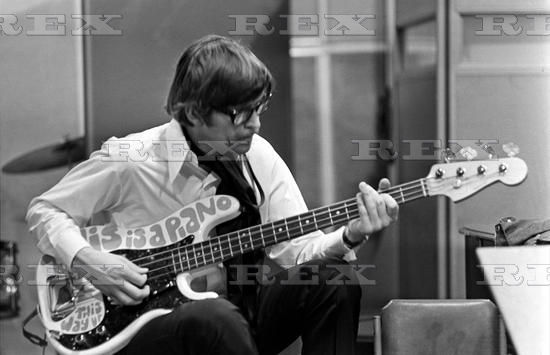
[source]

"This is a piano" and "This way up" were painted on the bass (apparently by White himself).  White later gave this bass to Jim Rodford, who used it (for mimed television appearances, at least) in Argent.  Here are some isolated frames from mimed performances of "Hold Your Head Up," which I'm including mostly because they're the only color images I've seen of this bass:


Sunday, November 3, 2019

Farfisa Compact Deluxe

Since around April, I've been interested in getting a bass pedal unit to use with my keyboard.  Specifically, I've been interested in the Hammond XPK-130G, which - as the Hammond website notes - is the same size as the bass pedals on the Hammond L-100, which is what Rod Argent used on "Time of the Season" (as he mentions at ~0:43 in this interview):


Instances of organ bass pedals in the material I cover with this project are very rare (if there are any at all).  In this short rendition of the opening/closing of "Rejoice" (on the organ at St. Albans Cathedral), Argent seems to use a few, and he might use some in "Pure Love" on All Together Now.  Anyway, in doing some research on bass pedals, I discovered something.

Months ago - probably as I was looking through the Zombie Heaven booklet again - I happened to notice what lookt like organ bass pedals in this picture of the Zombies rehearsing in the Philippines in March 1967:


(I just pulled this off the internet, but I'm pretty sure it's a scan of the Zombie Heaven booklet because the "1967" in the corner matches.)

In looking at this picture, I also noticed that Argent doesn't have his usual Hohner Pianet or Vox Continental.  For months, I've been trying to determine what keyboard he is using, and I finally found it this morning.  Based on pictures from this website, it's a Farfisa Compact Deluxe organ.  The writing on the back of the instrument in the Zombie Heaven booklet is too fuzzy to read, but it appears to be the same as that on the back of the Compact Deluxe:


The legs and overall shape are the same too.

Here's an-other picture (of a slightly different model) with the same distinctive curves in the music rest:


Based on a second Zombie Heaven booklet picture (in color) and the description on the website I found, both instruments are a gray/tan color:


(I scanned this from my copy of Zombie Heaven, and while the resolution is good, the quality isn't.)

Here's a side angle for comparison:


That solves the mystery of what keyboard this is, but it doesn't explain why Argent is using it instead of the Pianet and the Continental.  The best explanation I can come up with is that (perhaps because the shows in the Philippines were a residency) an organ was provided so Argent didn't have to bring his own.

Tuesday, June 4, 2019

Ready Steady Go!

[source]

I was looking through Zombies pictures recently and found this one, which I've never seen before.  The caption reads:  "English rock group The Zombies perform on the set of the music television show Ready Steady Go! at the Rediffusion studio in Kingsway, London in September 1964.  The band members are, from left, Rod Argent, Paul Atkinson, Colin Blunstone, Hugh Grundy and Chris White."

It's clearly early days since they're wearing the same stage clothes as they did during the Herts Beat competition in April and May 1964.  Rod Argent doesn't have his Vox Continental, just his Hohner Pianet (although, as I explain here, I think he got his Vox Continental in late August 1964), and it looks like Hugh Grundy is playing someone else's drum kit.  Based on what letters are visible ("ley... is... ts"), I think it might be Bill Haley & His Comets.

The Zombie Heaven liner notes list only one Ready Steady Go! appearance in September, on the 11th.  Paul Atkinson notes that because they did Ready Steady Go! they were late to a gig in Birmingham later the same day.

Sunday, February 24, 2019

Drop-In 1966

A little over a week ago, I was thinking about the pictures in the back of the I Love You liner notes booklet.  A year or two ago, bigger versions of a handful of these were posted either directly on the Zombies' Facebook page in the Zombies Fan Club.  I don't remember which, and I can't seem to find that post again, but it doesn't really matter because I tracked down the originals on DigitaltMuseum:

[source]

[source]

[source]

[source]

[source]

[source]

[source]

[source]

The caption for each of these reads:  "Den brittiska popgruppen The Zombies uppträder pÃ¥ TV-programmet Drop-In 1966."  Translated from Swedish, this reads:  "The British pop group The Zombies act on the television program Drop-In 1966."  According to the Zombie Heaven liner notes, the Zombies' 1966 Scandinavian tour started on 5 November and ended on 20 November.  (The same page contains five pictures from this performance [including the seventh and eighth above] with the caption "Live on stage in Sweden, November 1966.")

My search on the DigitaltMuseum site resulted in only these eight pictures, but the I Love You liner notes booklet has at least twenty-five.  Presumably, the others exist somewhere, along with - perhaps - film footage of the performance.

In looking at these pictures again, I discovered that the cover of I Love You was almost certainly shot at the same time.  In the background of the sixth picture, one can make out a bit of netting and the white lines of the red-and-white-striped goal posts the group is standing within on the cover:


Paul, Chris, and Colin all seem to be wearing the same clothes as in the above pictures.

Wednesday, February 1, 2017

The Odessey: The Zombies in Words and Images

Backdated, archival post

[link to original on tumblr]

---&---

[source]
I'm getting really excited about the new Zombies book.

Wednesday, December 28, 2016

Rod Argent

Backdated, archival post

[link to original on tumblr]

---&---


Rod Argent around 1980, found on page 59 of Rock Hardware on Google Books.

Wednesday, November 2, 2016

Zombies Newsletter

Backdated, archival post

[link to original on tumblr]

---&---

Here are a couple more things I wanted to note about the 1 November Zombies newsletter.

This picture from their recent photo shoot was included:


Chris White has a bass that says, "This is a piano" and "This way up," just like the one he used to record Odessey & Oracle (and - apparently - later gave to Jim Rodford):


---&---

There's a bit of an interview with Terry Quirk too, and it's mentioned that the figure on the Still Got That Hunger album cover is indeed inspired by Michelangelo (which I discovered back in February):


Here's the album cover again:


Tuesday, November 1, 2016

Rod Argent's Harmonica

Backdated, archival post

[link to original on tumblr]

---&---

[source]
I'd seen this picture before, but I didn't notice until now that Rod's holding his harmonica.