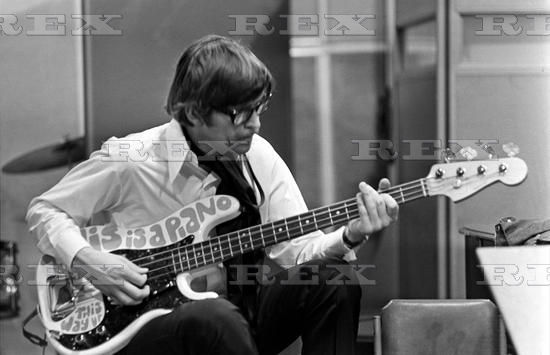
As part of my Collection Audit project, I'm listening to the Zombie Heaven discs again. I just listened to the third disc, and I noticed the lines "I want to hold you tight / While the warmth of the night surrounds us" in "You'll Go from Me" (the demo of what became "Don't Go Away"). I'm not sure of those line breaks, though.
In any case, these lines are fairly similar to some in "Maybe after He’s Gone," which - like "You'll Go from Me" - was written by Chris White. The last verse is: "I feel so cold; I'm on my own / As the night folds in around me / Night surrounds me; I'm alone."
The situations are the same: night is surrounding the speaker/singer, but there's a difference in temperature. In "You'll Go from Me" and "Don't Go Away" (the lyrics are the same; I think it's only the structure that's different), it's "the warmth of the night" because the speaker/singer is with a girl who loves him, but the speaker/singer in "Maybe after He's Gone" is "so cold" because he's alone.
Because I mentioned Rod Argent's harmonica in this picture (I'd never noticed it before), I feel like I should also mention that it's visible in this footage from 1964:
It's on top of his organ at about 1:21 (inexplicably, he doesn't seem to have his Hohner Pianette):
You can just make out some of the holes in the side. It also looks like there are some guitar picks near the corner of the organ. Paul Atkinson is standing next to him, so that makes sense.
Anyway, this is just to mention that both of these pictures seem to evidence that Argent played harmonica more during shows than in the studio. I think "I Got My Mojo Working" and "Work 'n' Play" are the only two Zombies songs that feature it.
This footage is labeled as "Halden 1964," and "NRK" stands for Norsk rikskringkasting (basically, the Norwegian Broadcasting Corporation). Jeg snakker norsk, men ikke godt; I did research. I lookt up the list of gigs in the Zombie Heaven liner notes, and while I didn't find Halden, the Zombies did tour the Scandinavian countries from 28 November to 8 December 1964. There's a quote from Colin, and he mentions that it was their first tour abroad, so it's quite remarkable that this - which is (apparently) the only extant footage of the 1960s Zombies performing an actual gig, and not on a television show of some kind - is from such an early period.
I searched the NRK website, but I couldn't even find this footage, let alone at a better resolution or more of it.
There's a bit of an interview with Terry Quirk too, and it's mentioned that the figure on the Still Got That Hunger album cover is indeed inspired by Michelangelo (which I discovered back in February):
According to the Zombie Heaven liner notes, fifty years ago to-day (1 November 1966), the Zombies recorded "Gotta Get a Hold of Myself," "Goin' out of My Head," and "This Old Heart of Mine" for "Saturday Club." The show was broadcast on 5 November.
I have a bunch of things I need to get around to writing. Here's something about "I Want Her She Wants Me" that I realized back in April:
The bass part at the end of the song just repeats the same figure (G D E G' E D G), and in some ways, this figure represents the mutual wanting in the title and lyrics. There are two G notes in the figure, and they're an octave apart. The phrase involves moving from one G up to the second and then back down to the first. So the ascent represents "I want her," and the descent is the reciprocal "She wants me."
According to the liner notes for both Zombie Heaven and The Decca Stereo Anthology, fifty years ago to-day (23 October 1966), the Zombies recorded "Goin' out of My Head" - the last song they recorded while at Decca. (The Decca Stereo Anthology also notes that "orchestral overdubs on 'Goin' out of My Head' [were] probably recorded at a later date.")
Unlike most of the Zombies' Decca-era recordings, this wasn't at Studio No. 2 in Decca West Hampstead. Zombie Heaven says just "Kingsway," but The Decca Stereo Anthology is more specific, citing "De Lane Lea, Portland Place."
I recently re-discovered Khan Academy, and I've been going through the Music Basics course. This morning I watched this video, which says that flats and sharps cannot be mixed in a key signature. I was wondering about that earlier this month when I posted my notation of the cello part in "A Rose for Emily." So while my notation is wrong from what I guess I would call an academic point of view, it's right from a tonal point of view. I wrote some notes in the wrong method, but they're still the right notes (I think).
Yester-day I watched the Zombies' concert at The Water Rats (be aware that there are a lot of quickly flashing lights in the video). It's a great performance. Tom Toomey and Steve Rodford both have brief solos in "She's Not There," which is a new feature, and it was good to see Jim Rodford playing his Mustang bass. The last time I saw it was during the Breathe Out, Breathe In sessions. And Rod Argent includes a quotation of Bach's Herz und Mund und Tat und Leben, BWV 147 in the solo in "Hold Your Head Up."
Anyway, I was reminded of the guitar riff that's been included in live versions of "She's Not There" since at least 2011. There were a couple times I'd thought it sounded pretty easy, and I finally figured it out last night.
In my recording, I have just the bass part that links the first chorus and the second verse and that guitar riff.
Here's the tab:
I referenced four different videos of live performances (on KEXP, SummerStage, the first Vintage TV appearance, and this second Vintage TV show at The Water Rats) to be as accurate as possible in that tab. (There's also the DVD of Live at Metropolis Studios, which I think may be the first appearance of that riff, but I didn't feel like digging it out.) I figured it out from audio recordings, and I was playing the last note in the third phrase (an A) as an open string, but in each of those videos, Tom Toomey plays it on the fifth fret of the E string.
I hadn't really considered the origin of this phrase before, but after figuring it out, I have a suspicion that Rod Argent's behind it. He wrote the song, so it makes sense, but there's also one of his trademark three-note chromatic phrases at the end (G G# A).
I have more notation this week (albeit late at night because my internet connection's been atrocious)! For the last week or two, I've been working on the cello part in "A Rose for Emily" (I'm hoping that becoming familiar with the cello part will help in figuring out the mellotron part). After spending some time trying to figure it out from the version on Zombie Heaven, I realized that by splitting the track, I could hear it better because it was a bit more isolated. And then I split the track with cello and mellotron from the 30th anniversary edition of Odessey and Oracle, and I found that it's even easier to hear there. So I think what I have is more accurate than if I'd just listened to the tracks as they are on the CDs.
I'm a bit unsure of the key, but I put it in A major because that's what the song resolves to. I have a couple piano markings, but they apply only to the notes they're above (C#s).
It wasn't until going over this again before I scanned it that I discovered that there's an-other Argentian three-note chromatic phrase. At the end of the fifth line into the sixth, there's G# A Bb. (Although maybe I shouldn't be mixing sharps and flats like that.)
For some reason, as I was going over this, it kept reminding me of "Greensleeves," but - so far, at least - I can't really find any resemblance.