I decided to refresh my knowledge of the bass part for "I Must Move" before I started recording my own version. In doing so, I discovered that I actually had a note wrong. What I always thought was an A is actually an F. This called the guitar part into question (I'd been suspicious of that part of it anyway), and what I thought was an A major is actually an F major. I am duly embarrassed by this, but I am also excited because of the musicological implications.
That F major chord and F note are both accidentals in the song (which is in D major, for the most part). They occur at the end of the "I must move, I must move" parts, corresponding to the "go" in "I must go." So there's musical movement to that accidental, and there's movement in the "go" in the lyric.
I added some reverb to the guitar part. It's that way in the original, but I still don't really know what I'm doing with reverb.
Back in January I listened to Andrew Bird's Andrew Bird and the Mysterious Production of Eggs for my Collection Audit project, and I thought the guitar part at the beginning of "Banking on a Myth" sounded like a phrase in Argent's "Pure Love" - the organ phrase at the beginning of II. Prelude.
I finally got around to checking that, and - while I still think it's just coincidental - they're very similar. The phrases are different lengths, but the first halves of each are pretty much the same, except for the keys and some note values.
In any case, in re-learning that organ phrase (I learnt it [or sort of learnt it] back in 2014), I also learnt the bass and guitar parts that go under most of it. But I won't get to recording and posting that for a few days because I still have these historical recordings to get through and then the riff from "Play It for Real." But, coming soon: rhythm parts for "Pure Love: II. Prelude."
I actually had to record this twice. After I recorded the keyboard parts the first time, I referenced my old recording (from over a year ago!) because I couldn't quite remember a few phrases in the bass part. But my audio recording software doesn't like it when I listen to stuff while it's still open. It gets static-y. I tried working through it, but after I'd recorded the bass and guitar parts and exported the track, the later parts were very obviously not in sync with the earlier ones. So I just started all over.
I'm listening to the Zombies' Breathe Out, Breathe In. I remember reading something (I think it was around the time the album came out) that compared the piano riff in "Play It for Real" to that in the Beatles' "Hey Bulldog." I'd sort of dismissed this as, "Yeah, they sort of sound alike," thinking that the big similarity was just that they were both piano riffs. Listening to it this time, that similarity was very obvious tonally (probably because I learnt how to play the riff from "Hey Bulldog" back in November and haven't listened to Breathe Out, Breathe In since last May).
Because I already knew the riff from "Hey Bulldog," I learnt the riff from "Play It for Real" in order to compare them, and I was surprised by how similar they are musically. The riff in "Hey Bulldog" is in B minor where the riff in "Play It for Real" is in A major, but - as far as scale degrees - the riffs are exactly the same (up to a point at least; the riff in "Play It for Real" is longer and more developed than that in "Hey Bulldog"). I tried notating them, but they're beyond my notational skills, so I'll just have to describe them.
Both riffs start with two tonic notes (B B in "Hey Bulldog;" A A in "Play It for Real"). Then there's the third note of the scale (a D in B minor [a minor third] for "Hey Bulldog;" a C# in A major [a major third] for "Play It for Real") before going back to the tonic. That third starts a skipping between sequentially higher notes and the tonic, and that skipping figure is capped with an ascending half-step from augmented fourth to a perfect fifth. So - in full - it's B B D B E B E# F# in "Hey Bulldog," and - as far as it matches "Hey Bulldog" - A A C# A D D# E in "Play It for Real."
The rhythms start to differ near the end of that first phrase, but tonally, they're very similar. The only differences are the key each is in and that one has a minor third where the other has a major third.
Rod Argent (the Zombies' keyboard player) has talked about the Beatles' influence in some interviews, so I think this is a likely instance of influence even if it was a conscious influence.
I'm queuing this, so it won't show up until 2 March, and by then I'll be busy recording some songs for the historical anniversaries, but after that I'll get around to recording and posting the riff from "Play It for Real."
According to Russo's Collector's Guide, fifty years ago to-day (28 February 1966) the Zombies' "Is This the Dream" b/w "Don't Go Away" (PAR 9821) was released in the U.S. and Canada.
When I started recording the songs on the anniversaries of their originally being recorded, I substituted the studio version (if there was one) for the live version. This particular recording of "Can't Nobody Love You" - while for the anniversary of the radio appearance - is still based on the studio version, but at some point, I need to start learning the differences between the studio and live versions. I'm pretty sure the live version of "Can't Nobody Love You" features a regular six-string guitar instead of twelve-string (which would make it much easier to play). I'm also curious about the bass part; I think I noticed a slight error in the bass part of the studio version, so I want to see whether it's in the live version or not (to see if it really is an error).
I don't really have the time to compare the different versions now, but eventually, I'd like to get around to it.
I have a Google Document where I have a list of the Decca-era recording dates, but because I apparently can't remember them correctly, I've also added them as a page on this blog. They're a little more accessible that way.
I need to go through and hyper-link all the songs, but hopefully it's useful just as it is.
I was under the mistaken impression that to-day was the 50th anniversary of the Zombies' performance of "Rip It Up" and "Can't Nobody Love You" on the radio, but it's actually the 51st (it was in 1965). In any case, I'm still recording the songs on their historical anniversaries, so here's the bass part for "Rip It Up" (it's all I know so far).
I never actually got around to writing the bass part in notation (or even attempting to write it in notation). There are some pretty easy edit points though, so I combined three takes to get this.
"Rip It Up" is a rock and roll standard, but the Zombie Heaven liner notes mention Little Richard's version specifically. I went through all of the versions I have, and the Zombies' version is in the same key as his (F major), so it seems like it really was the most influential for them.
For the record, Bill Haley's is in C major; Buddy Holly's (which I have on Down the Line: Rarities, so I don't think it was ever officially released) is in D major; Elvis' is in A major; the Everly Brothers' is in C major; and the Beatles' version (on Anthology 3) is in A major.
This morning I listened to the first disc of Bob Dylan's Blonde on Blonde (and I'm listening to the second disc now). I found something in "Visions of Johanna" that both excited and confused me.
At about 3:49, there's a short guitar riff:
This is the fifth song I've found that riff in (which is the exciting part), but now I have even less of an answer to questions of influence (which is the confusing part).
I first found that riff in the Zombies' "Telescope (Mr. Galileo)" (there are two versions on Into the Afterlife, but that riff is only in the second version - the one with fuzz guitar). Then I found it in the Moody Blues' "So Deep within You" from On the Threshold of a Dream. A few months later, I stumbled across it in the Tremeloes' "Hello World." And then I also found it (albeit on piano) in Colin Blunstone's "Caroline Goodbye" from One Year.
"Visions of Johanna" predates all of those though. It's from 1966. "Telescope (Mr. Galileo)" is from 1968 (but wasn't released until 2007). "So Deep within You" and "Hello World" are both from 1969, and "Caroline Goodbye" is from 1971.
Finding that same phrase in this Dylan song still doesn't clear up everything, but it does introduce a new line of influence. The Tremeloes covered Dylan's "I Shall Be Released" at the end of 1968, so they were familiar with him, possibly including that particular riff in "Visions of Johanna."
A strumming pattern in "Visions of Johanna" also stuck out to me. I'm not sure if I have the chord phrasing right, but it's something like:
There's an Asus4 that modulates to an A major. With a slight difference (modulating to A minor rather than A major) that same rhythm is in the Zombies' demo of "Call of the Night":
"Call of the Night" was later re-workt into (and put into a different key for) "Girl Help Me," but that feature is present there too.
I'm not sure if any of this really provides evidence that any of these musicians were influenced by an-other, but their songs at least share some similar features that I thought interesting.
I found more stuff about that riff in "Telescope (Mr. Galileo)" and "Caroline Goodbye," but it doesn't really clear anything up.
I might have found a Dylan influence on "Call of the Night"/"Girl Help Me" though.
I just watched a TED talk on the Sistine Chapel, and - while it wasn't mentioned in the actual lecture - I noticed a figure in The Last Judgement that lookt familiar to me.
On the right side, about two thirds down, there's a man in a crouching position, covering the left side of his face with his left hand. (Here's a link to a larger image because it's pretty hard to see in what I've embedded.)
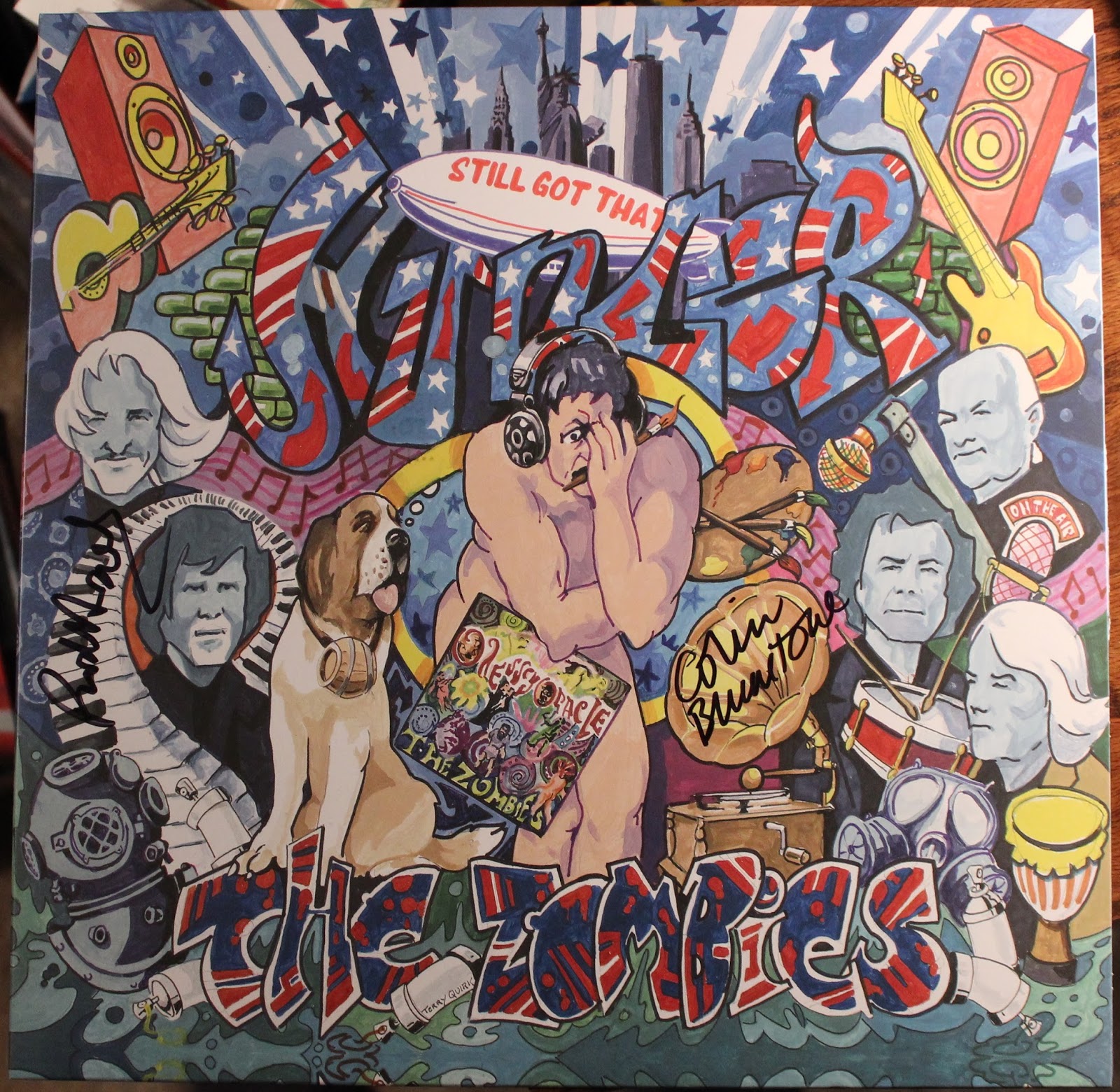
That same posture is on the cover of Still Got That Hunger:
I can't seem to find it again, but I remember reading something that Rod Argent said about some hidden things in the artwork. Previously, I noticed only the "On the Air" on the microphone to the right of Blunstone, which I thought was a reference to his On the Air Tonight album, but I think using the same posture as that figure in Michelangelo's painting is more the type of thing that Argent was talking about.
According to the Zombie Heaven liner notes, fifty years ago to-day (10 February 1966) Bunny Lake Is Missing (with the Zombies' extremely brief appearance) premiered at the Odeon, Leicester Square.
I just learned the bass part for the version of "Rip It Up" that the Zombies performed for "Top Gear" in February 1965 (the anniversary's coming up at the end of the month, which is why I was working on it). I'm having trouble remembering what sections have what parts though (it's sort of modular), so I'm probably going to have to write out the notation for it (or try to write out the notation for it) before I can attempt recording a version, and - in that case - I'll probably just wait until the end of the month.


#/media/File:Last_Judgement_(Michelangelo).jpg)